Sign once, stay compliant
- Protect your license and your DEA number
- Approve CURES reports in a tap
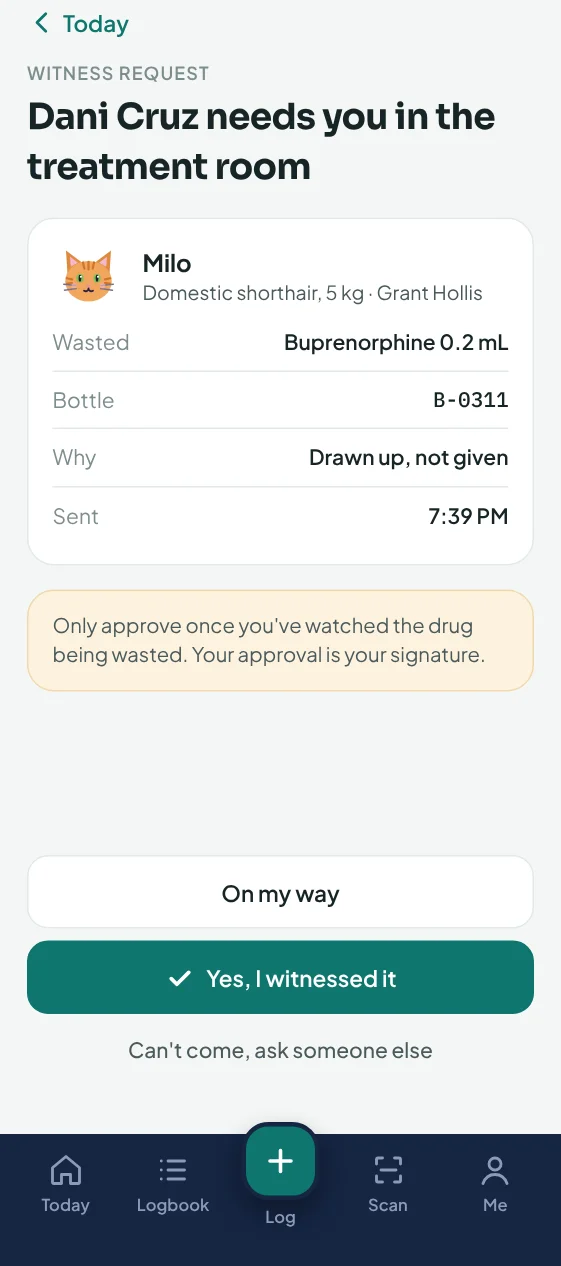
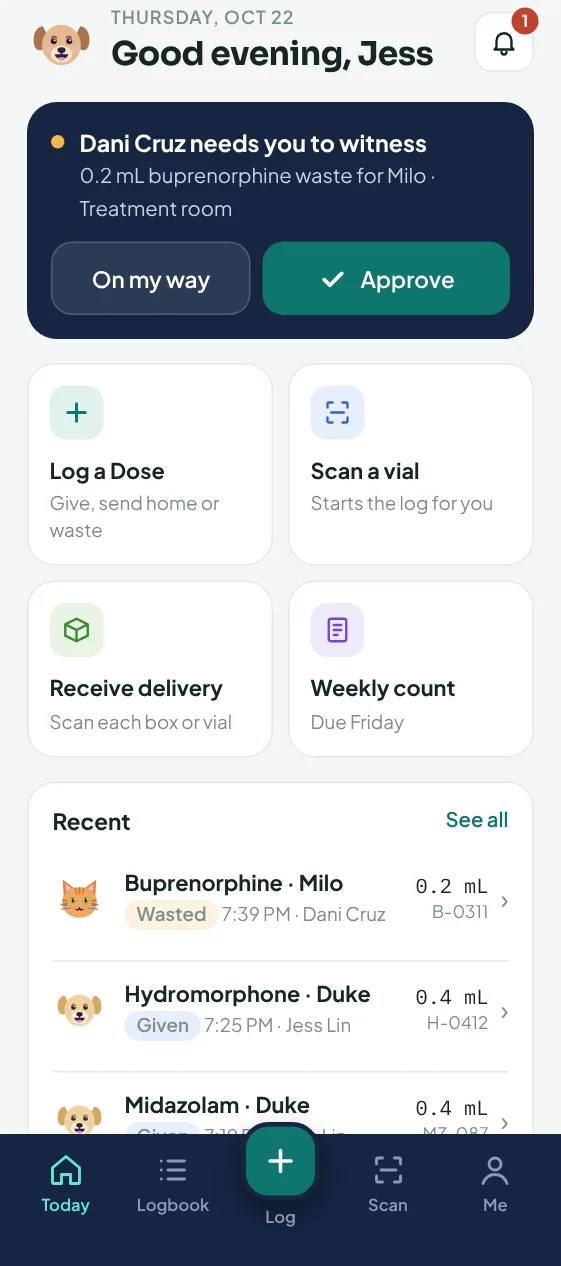
- Witness from your phone between patients
Aesier builds simple, well-designed software for veterinary teams. We start with the jobs that eat staff time and invite mistakes, and make them quick and easy to get right.


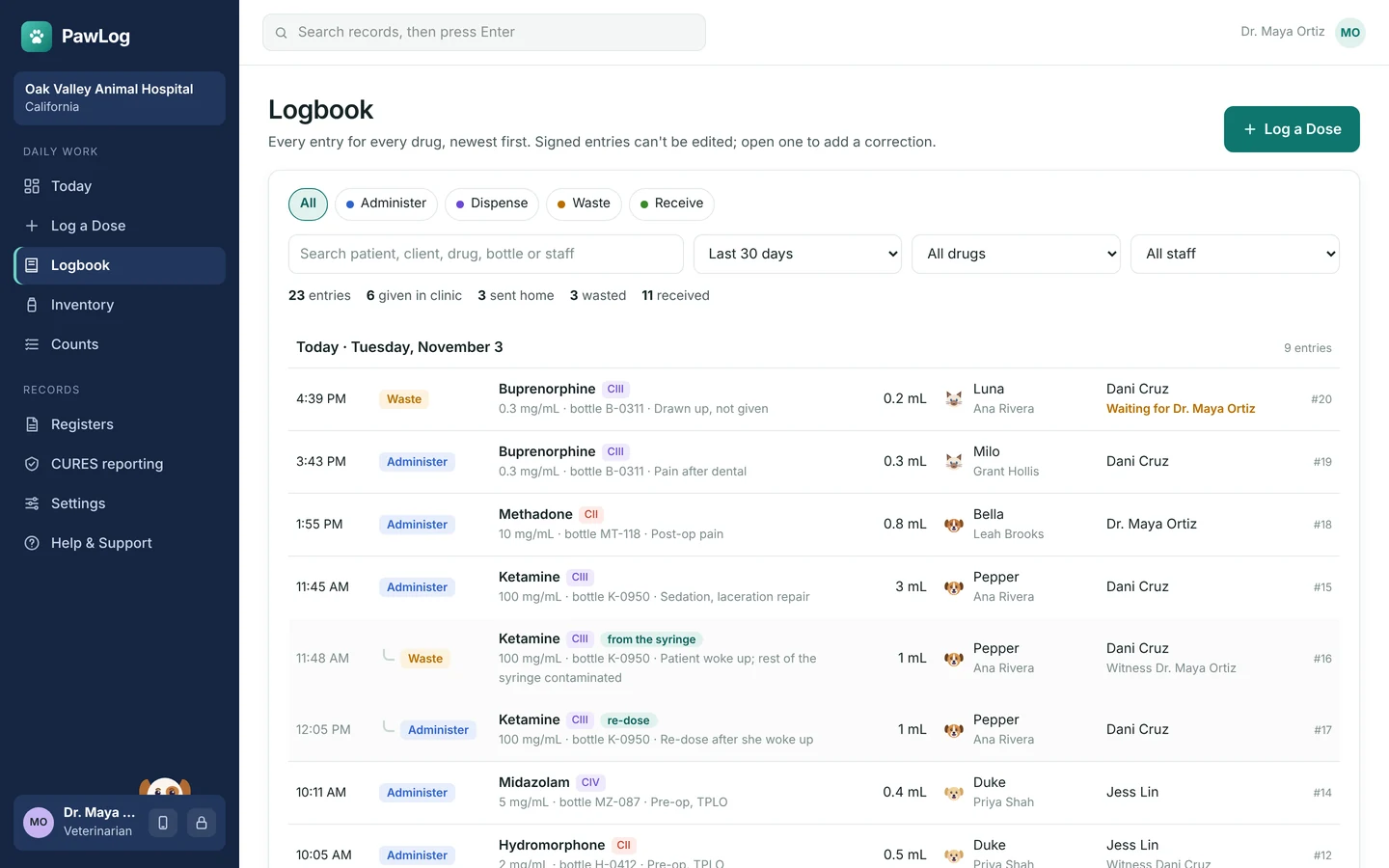
Every controlled drug's life in your clinic, in one place, signed by the right people at the right time.
Log doses by voice, witness from your phone and scan deliveries, so the log keeps up without slowing down care.
Complete, signed records for every vet's DEA registration, exported in one click.
Live bottle balances catch a missing entry the same day, not at the weekly count.
Signed records can't be changed, waste is witnessed, and CURES reports go out on time.
If your vets hold a DEA registration and log controlled substances, PawLog is built for you, whatever animals you treat.
Our founders want to support nonprofits. Zoos, animal shelters, rescues and wildlife centers already stretch every dollar, so they get PawLog at a reduced price.
Aesier started in a California general practice where controlled drugs were still logged on paper. We watched vets write entries at the end of long shifts and technicians hunt for a witness. We built this software so that time goes back to the animals.
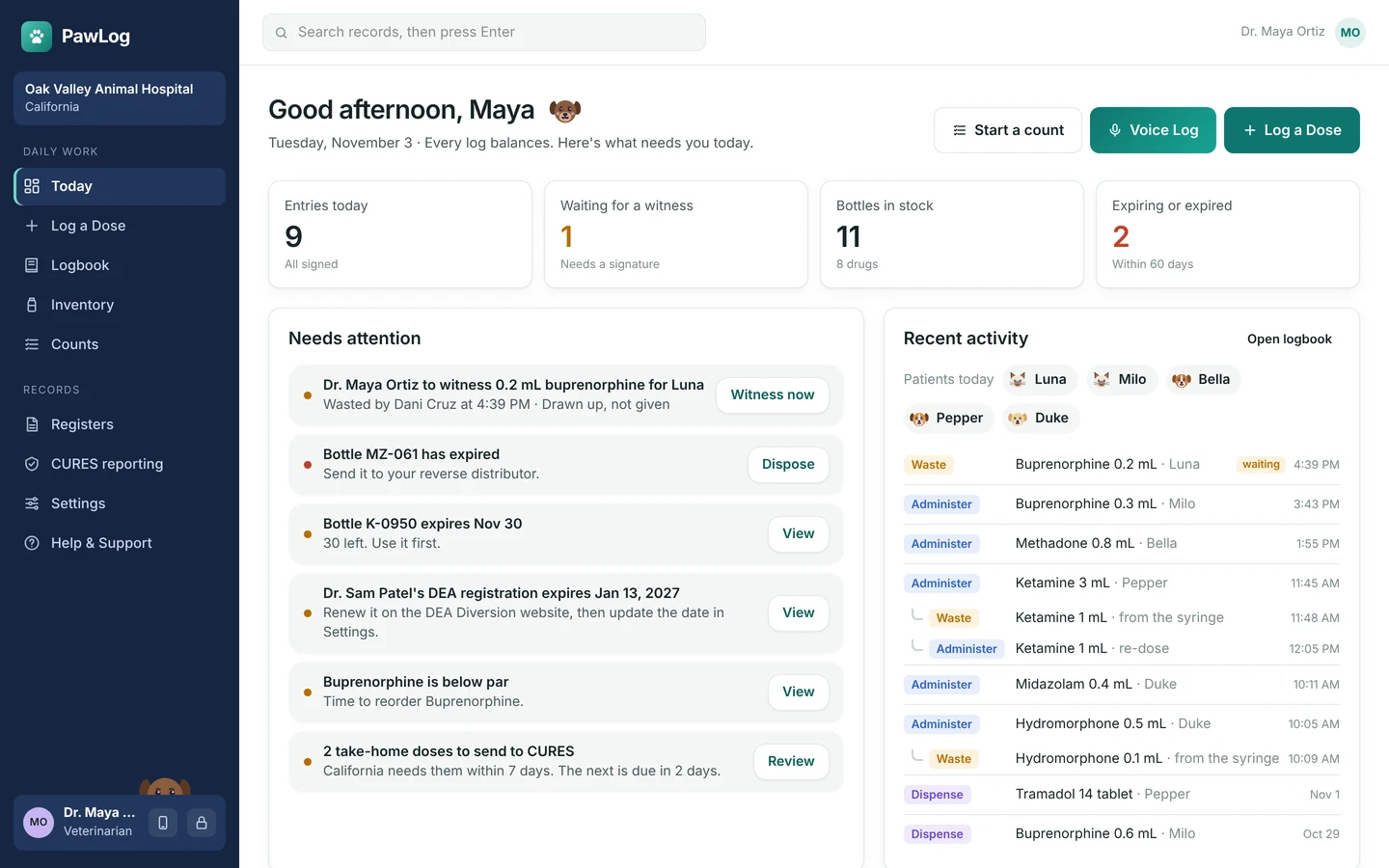
About AesierPawLog replaces the paper controlled-substance log. Log a dose in a few taps or let our hands-free voice tool log it for you, get a witness to sign from their phone, and know every bottle balances before an inspector asks.

Our California pilot is up and running, and we're welcoming new founding clinics. You get hands-on setup, founding pricing and a direct line to the team behind PawLog.
What the rules say and five habits that keep a log current.
California · 2 min readWhat to report, by when, and what CURES needs from you.
Self-check · 21 questionsCheck off what's true today and see what to fix first.
See PawLog with your own drugs, safes and team in a 30-minute call. For veterinary clinics in the United States.
PawLog replaces the paper controlled-substance log. Log a dose in a few taps or let our hands-free voice tool log it for you, get a witness to sign from their phone, and know every bottle balances before an inspector asks.


The two jobs that take longest on paper, done in seconds. Pick a demo and watch it run.
The website runs on the clinic's computers and iPads. The phone app is for witnessing, quick logging and scanning on the move.


No binder at the end of the shift and no balance to work out by hand. Each step takes seconds and lands in the same logbook.
Scan each box or vial. PawLog reads the drug, lot and expiry, then one signature checks the order in under the right vet's DEA number.
Tap the drug, patient and amount, or say "gave 3 mL ketamine to Pepper for induction" and check what PawLog heard.
The vet next door gets a request on their phone and signs with one tap. Nobody leaves a patient to find a pen.
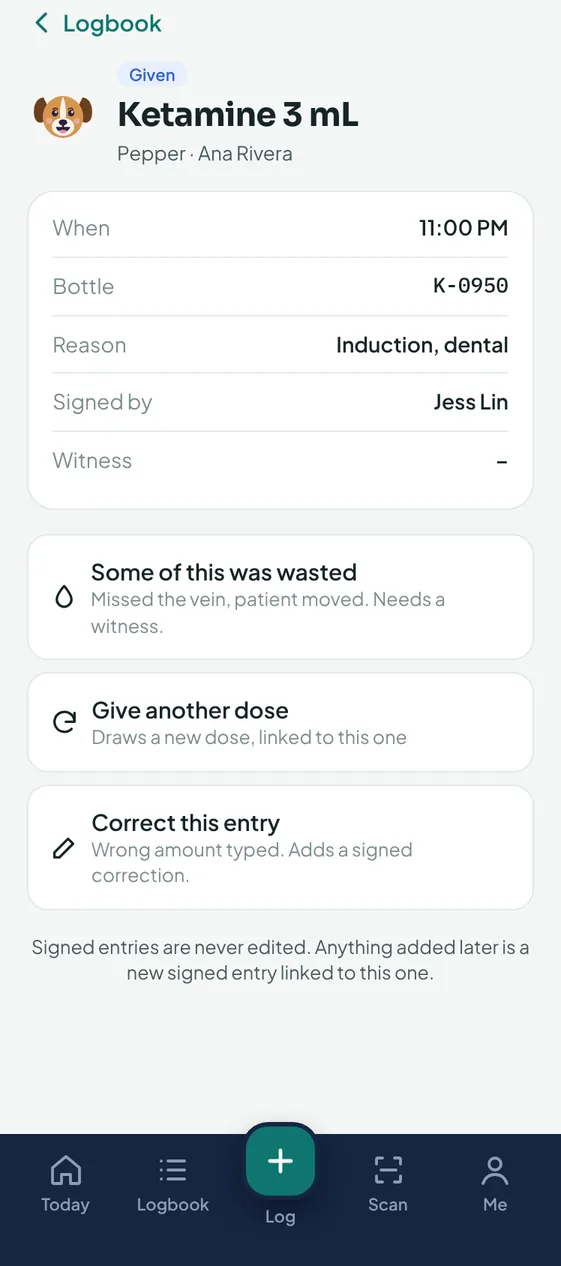
Add the waste to the original dose. Later waste, re-doses and corrections are new entries linked to the first.
PawLog shows what each bottle should hold. Enter what you see. Normal hub loss is allowed for, and any real mismatch opens a discrepancy record straight away.
Built around the jobs vets and technicians do every day, so the common ones are the fastest.
Speak the whole entry hands-free, without taking your gloves off. PawLog fills in the drug, amount, patient and reason, and you check it before signing.
Send a witness request to a colleague's phone. They sign with Face ID, a fingerprint or one tap on the notification, and get a text if notifications are off. The entry shows "Waiting" until they do.
Point the camera at the barcode on the box to receive stock, or at a bottle to start a log. Lot and expiry fill in for you.
What was drawn up, given, wasted and corrected, with every signature and time, in one timeline.
Balances update as you log. Daily counts and the biennial inventory are guided, signed and saved.
CURES reports generated automatically for take-home dispensing, Form 41 and Form 106 drafts, and a one-click export of every register when an inspector visits.
We're working with the major practice management companies to link PawLog to your patients, clients and invoices, so details fill in on their own and anything billed but not logged gets flagged.
Using something else? Tell us and we'll reach out to them.
Entries written hours later are where most log problems start: forgotten doses, guessed amounts and witnesses who weren't there. PawLog makes logging on the spot the fastest option.
Why it mattersPawLog keeps the records your registration asks for, in the shape an inspector expects, and won't let anyone quietly change them.
A 30-minute call. We'll set it up with your safes, drugs and vets.
Most controlled drug log problems don't come from bad intentions. They come from a busy day and an entry written hours later from memory. Here's why logging in real time matters, and how to make it the easy habit.
Every registrant required to keep records … shall maintain, on a current basis, a complete and accurate record of each substance manufactured, imported, received, sold, delivered, exported, or otherwise disposed of by him/her.21 CFR 1304.21(a), federal DEA record-keeping rules
"On a current basis" is the key phrase. The record is meant to keep up with the drugs, not catch up with them at the end of the day. Your state may add its own rules on top, so check those too. This page is general guidance, not legal advice.
Each of these is easy to fix on the day and hard to explain weeks later.
A quick top-up during a busy afternoon is the easiest entry to miss. Nobody notices until the count is off.
"About half a mil" becomes 0.5 mL in the book. Small guesses on every entry drift the bottle balance away from what's really in it.
A waste signed at the end of the day isn't really witnessed. It's one of the first things an inspector looks at.
A mismatch found at the weekly count means piecing together a week of shifts while people try to remember.
Gaps between giving a drug and logging it are exactly where loss and diversion go unnoticed.
Catching up on the log after a long shift is tiring, and tired entries are where mistakes creep in.
| Logged later | Logged in real time | |
|---|---|---|
| Amount | Remembered, often rounded | Exact, taken from the syringe in hand |
| Time | Approximate or the time it was written | Recorded automatically |
| Witness | Often signs afterwards | Signs while watching, from their own phone |
| Bottle balance | Worked out at the count | Always up to date |
| A missing entry | Found at the next count, days later | Obvious the same day |
| Who remembers | Whoever is still around | Nobody has to |
Nobody chooses to log later. The binder is in another room, gloves are on, the witness is in surgery and the next patient is waiting. Fix those and the habit takes care of itself.
Say the entry out loud, hands-free. PawLog fills in the fields and you check them before signing.
See voice loggingSend the request to their phone. They watch, then sign from their phone where they're standing.
See witnessingScan the bottle or the box. Drug, lot and expiry fill in from the barcode.
See scanningThe log is on every computer, iPad and staff phone, so it's always where the drugs are.
See the screensNot after the procedure, not at lunch. The syringe in your hand is the most accurate record you'll ever have.
The witness watches the drug being wasted, then signs. If they can't come now, ask someone who can.
Add a dated correction that points to the original, so the history stays visible.
A short daily count for Schedule II catches problems while people still remember the shift.
Favorite doses, voice entry and phone witnessing turn a two-minute chore into a ten-second one.
A 30-minute call. We'll set it up with your safes, drugs and vets.
Most practice management systems (PIMS) keep a controlled drug history. Whether that history can serve as your DEA log depends on how it's built and how your team uses it. Here's how to tell, and what to do if it falls short.
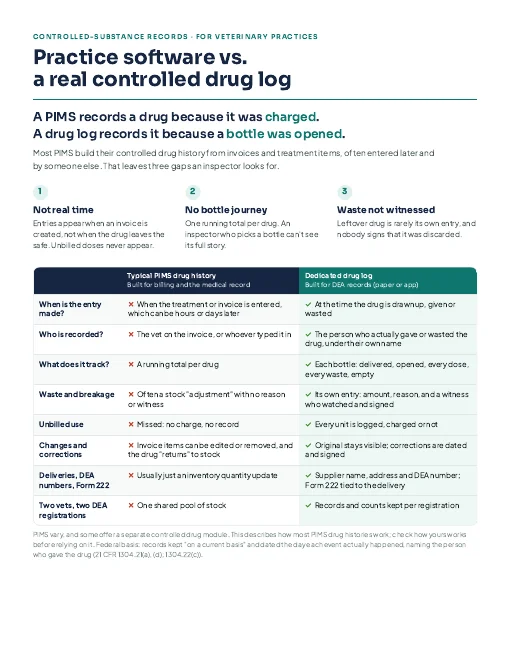
In most clinics, the PIMS records a drug because it was charged. A drug log records it because a bottle was opened.
Most PIMS build their controlled drug history from invoices and treatment items, often entered later and by someone else. Federal rules ask for records kept "on a current basis", dated the day each event actually happened, naming the person who gave the drug (21 CFR 1304.21 and 1304.22). When the history is built from invoices, three gaps usually appear.
Entries appear when an invoice or treatment is created, not when the drug leaves the safe. A dose drawn up but never charged never appears at all.
Stock is one running total per drug. An inspector who picks a bottle and asks for every mL, from delivery to empty, can't see its story.
Leftover drug is often just a stock "adjustment", if it's recorded at all, with no reason and no second person signing that it was discarded.
It's the most common answer we hear from practice managers, and it's a fair one. Your practice software already knows which patient got which drug, how much, and which vet was on the case. Why keep a second record?
The answer starts with what DEA actually asks for. Federal rules don't name a format or approve any software. They ask each DEA registrant to keep a complete and accurate record of every controlled drug received and every unit that leaves stock, "on a current basis", dated the day it really happened, and naming the person who gave or dispensed it (21 CFR 1304.21 and 1304.22). Paper, a PIMS or a dedicated app can all meet that. The question is whether yours does.
Most PIMS were built to bill clients and keep the medical record. Their controlled drug history usually comes from the same place as the invoice: a treatment item added to a patient's visit. That works for the chart. But it means the record appears when the invoice is entered, which may be hours later and by someone at the front desk. A dose drawn up for a patient who was never charged, a top-up during surgery, or the half milliliter left in a syringe often never appears at all.
Over a few weeks those small gaps add up. The total in the software drifts away from what's on the shelf, and when a count is off there is no entry that explains why. Stock "adjustments" fix the number but not the story, and the story is what an inspector asks for.
DEA and state inspectors usually pick a few bottles and ask the clinic to account for every unit: when it arrived, who gave each dose, what was wasted and who saw it, and what's left. They look at Schedule II order forms, the last biennial inventory, and whether records can be pulled for each vet's registration. A billing history rarely answers all of that on its own.
"On a current basis" is the key phrase in the federal rule. The record is meant to keep up with the drugs, not catch up with them at the end of the day. An entry written hours later is written from memory: amounts get rounded, a quick top-up gets forgotten, and a witness ends up signing for a waste they didn't see. A record made at the safe, by the person holding the syringe, is the most accurate one you'll ever have, and it's the only way a missing entry shows up the same day instead of at next week's count.
People who used to do these inspections are blunt about where clinics fail. Jack Teitelman, a retired DEA supervisory agent, told AAHA that "recordkeeping is absolutely number one," and that when his firm audits veterinary hospitals, most have incomplete records and "most would get a violation." He puts most of it down to busy staff: "human error [or] mathematical issues" (AAHA NEWStat).
DEA compliance experts quoted in industry articles say the same about timing: the controlled drug logbook is often cited as the main source of infractions during audits, writing usage down when you use it is the only way to avoid missed entries, and relying on invoices that can be modified, inaccurate or delayed puts a clinic at a disadvantage.
Recent federal settlements with veterinary clinics tell the same story. The findings are rarely dramatic: drugs that couldn't be accounted for, Schedule II deliveries that were never recorded, no biennial inventory, and losses that weren't reported. Civil fines run up to $19,246 per recordkeeping violation, and every missing entry can count.
Keep the PIMS. It's the right place for the medical record and billing. Then check its controlled drug features honestly against the questions below. If it passes, great. If it doesn't, keep a real drug log next to it, on paper or in an app, filled in at the safe by the person giving the drug, and use the PIMS invoices to double-check the log rather than to create it.
PIMS vary, and some offer a separate controlled drug module. This is how most PIMS drug histories work.
| Typical PIMS drug history | Dedicated drug log | |
|---|---|---|
| When the entry is made | When the treatment or invoice is entered, hours or days later | When the drug is drawn up, given or wasted |
| Who is recorded | The vet on the invoice, or whoever typed it in | The person who actually gave or wasted the drug |
| What it tracks | A running total per drug | Each bottle: delivered, opened, every dose, every waste, empty |
| Waste and breakage | A stock adjustment with no reason or witness | Its own entry with amount, reason and a witness |
| Unbilled use | Missed: no charge, no record | Every unit is logged, charged or not |
| Changes | Invoice items can be edited or removed, and the drug "returns" to stock | Original stays visible; corrections are dated and signed |
| Deliveries and Form 222 | Usually just a stock quantity update | Supplier name, address and DEA number; Form 222 tied to the delivery |
| Several vets | One shared pool of stock | Records and counts kept per DEA registration |
If you can answer yes to all five, your PIMS may be able to serve as your drug log. Each "no" is a gap to close.
At the time the drug is drawn up, not when the invoice is entered.
Under their own login, not the vet on the invoice or whoever typed it in.
Every dose, every waste, and a balance that matches the shelf today.
Amount, reason, and a second person who watched and signed, not a stock adjustment.
Edits show who, when and why; receipts carry the supplier's DEA number and Form 222; biennial inventories are signed and kept per vet.
Billing, the medical record, and the dose, quantity and frequency your state requires in each patient's chart.
Whoever draws up or wastes a drug logs it right then, under their own name, with a witness on waste.
A daily look at billed controlled drugs against the log catches anything missed while people still remember the shift.
A 30-minute call. We'll set it up with your safes, drugs and vets.
If your vets send controlled drugs home with clients, California requires each dispense to be reported to CURES within 7 days. PawLog collects what CURES needs while you log and tells you what's due.
Schedule II to V drugs dispensed for use at home are reported. Doses given in the clinic are not.
Each dispense must reach CURES within 7 days. There's no exemption for small amounts.
CURES needs the owner's name, address, phone and date of birth, plus the drug, quantity, days' supply and the vet's DEA number.
Each California vet with a DEA registration also needs a CURES account, whether or not they dispense.
Choose "Send home". PawLog asks for anything CURES needs that the client record is missing, such as date of birth.
The CURES page and the Today page list every unreported dispense with the days left, for each vet.
PawLog checks each record for missing or badly formatted details before it goes anywhere.
PawLog builds the report in CURES's format as you log. Nothing goes to the state until someone at your clinic approves it, and PawLog shows when it was submitted.
A 30-minute call. We'll set it up with your safes, drugs and vets.
Or pay yearly and get 2 months free.
General practice, emergency and specialty clinics. Techs and staff free.
Get started40% off for shelters, rescues, zoos and wildlife rehabilitation centers.
Ask about nonprofit pricing| PawLog | Other drug log software | Drug cabinet systems | |
|---|---|---|---|
| Onboarding fee | $0 | Often $150 or more | Installation, often extra |
| State PMP reporting | Included | Often a paid add-on | Often a paid monthly module |
| Voice logging | Included | Rarely offered | Rarely offered |
| Techs and staff | Free | Varies | Varies |
| Hardware to buy | None | Often sold with it | $10,000+often per cabinet |
| Works with the safe you have | Yes | Yes | No, it replaces it |
| Contract | Month to month | Varies | Often multi-year |
We add your vets, their DEA numbers, your safes and the drugs you stock.
The practice manager adds staff, and each person connects their phone and chooses a PIN.
Count every bottle on day one. That count becomes your starting balance.
Start logging in PawLog. Keep your paper logs for as long as the rules require.
A 30-minute call. We'll set it up with your safes, drugs and vets.
A controlled drug log only helps if nobody can quietly change it and it's there when an inspector asks. Here's how PawLog handles both.
No one can edit or delete a signed entry. Corrections are new signed entries that point to the original, and every record is sealed in a tamper-evident chain.
Every signature belongs to one person, by PIN or Face ID. Shared computers lock after 5 minutes.
Data is encrypted on the way to our servers and while it's stored.
Daily backups that can be restored to an earlier point in time, plus an optional monthly PDF of your logs to keep on site.
Each clinic's records are walled off from every other clinic's. Viewing or exporting records is itself logged.
Your clinic owns its records. We never sell them, and you can export everything at any time.
PawLog is built around 21 CFR 1304 and California's veterinary and CURES rules.
A 30-minute call. We'll set it up with your safes, drugs and vets.
Everything clinics ask us about logging, witnessing, voice and scanning, DEA rules, CURES, setup, security and pricing.
A 30-minute call. We'll set it up with your safes, drugs and vets.
Practical guides for vets, technicians and practice managers, whether or not you use PawLog. These are general guidance, not legal advice. Check your own state's rules.
Check off what's true for your clinic today. Anything left unchecked is worth fixing first. Your answers are saved in this browser only.
California's prescription monitoring program, CURES, tracks Schedule II to V drugs that leave a clinic for use at home. If a vet dispenses one of these drugs to a client, the dispense must be reported within 7 days. Doses given in the clinic are not reported.
Each report needs the owner's name, address, phone number and date of birth, along with the drug, quantity, days' supply and the vet's DEA number. Collecting the date of birth at the time of dispensing saves chasing it later.
Every California vet with a DEA registration needs a CURES account, even if they never dispense. The vet stays responsible for timely, accurate reports, even when staff or software prepare them.
Pick a start date at the start of a week, when the team isn't stretched.
Count everything on day one. The opening count becomes each bottle's starting balance in the new log. Record whether it was taken at opening or close of business.
Close the paper log with a final line and signature on the same day, and keep the paper books for the full retention period. That's at least 2 years federally, and in California 2 years from the record or 3 years from the animal's last visit, whichever is longer.
Run a count after the first week to catch any habits that need fixing.
A written standard operating procedure tells every staff member the same thing and shows an inspector you have a system. Cover these headings:
A 30-minute call. We'll set it up with your safes, drugs and vets.
Aesier is a small California company building tools for veterinary clinics. Our first product, PawLog, started in a general practice where controlled drugs were still logged on paper. We saw vets writing entries at the end of long shifts, technicians hunting for a witness, and practice managers dreading the count.
If logging takes longer than the procedure, people log later. We make the right entry the quickest one.
We say exactly what our products do and don't do. We'll never call our software "DEA approved", because no software is.
Every screen is tested with the vets and technicians who use it, starting with our first clinic in California.
No long contracts and a full export whenever you want it. We want you to stay because our software helps.
A 30-minute call. We'll set it up with your safes, drugs and vets.
How Aesier LLC collects, uses and protects information on this website and in PawLog.
This Privacy Policy explains how Aesier LLC ("Aesier", "we", "us") handles information when you visit aesier.com (the "Website") or use PawLog, our controlled-substance logbook for veterinary clinics, including its website and mobile apps (the "Service"). If you have questions, email hello@aesier.com.
Clinic records. When a veterinary clinic uses PawLog, the clinic decides what goes into it: controlled-drug entries, inventory, counts, staff details, and patient and client details. We hold and process these records on the clinic's behalf and only to provide the Service. The clinic that signed up (the "Customer") controls them. If you are a pet owner and want to see or change information a clinic recorded about you, please contact that clinic.
Information about you as our user or visitor. This covers people who visit the Website, contact us, or have a PawLog account. For this information, Aesier decides how it is used, as described below.
We never sell personal information or clinic records, and we never share them for advertising.
Clinic records are kept while the clinic is a Customer. Signed records are never deleted during that time, because controlled-substance rules require them to be kept. After a Customer leaves, we keep records read-only for at least 3 years so the clinic can meet its retention duties, and then delete them unless the clinic asks us to keep them longer or the law requires it. Contact and support emails are kept as long as needed to deal with them and for our business records.
Data is encrypted in transit and at rest, each clinic's records are kept separate, access is limited to people who need it, and records are backed up daily. No system is perfectly secure. If a breach affects your information, we will notify the affected Customers and people as the law requires.
You can ask us to access, correct or delete information about you that Aesier controls, or ask what we hold. California residents have these rights under the California Consumer Privacy Act, including the right to know, delete and correct personal information, and not to be discriminated against for using these rights. We don't sell or share personal information as those terms are defined there. For information inside a clinic's records, we'll pass your request to the clinic, which decides how to respond, because records required by controlled-substance rules may need to be kept. Email hello@aesier.com to make a request. We may need to confirm who you are first.
The Website and Service are for veterinary professionals and are not meant for children under 16. We don't knowingly collect their personal information.
We store data in the United States.
If we change this policy, we'll update the date above. If the changes are significant, we'll tell Customers by email or in the Service before they take effect.
Aesier LLC · 2108 N St, Ste N, Sacramento, CA 95816 · hello@aesier.com
The terms for using aesier.com and PawLog.
These Terms of Use ("Terms") are an agreement between you and Aesier LLC ("Aesier", "we", "us"). They cover aesier.com (the "Website") and PawLog, including its website and mobile apps (the "Service"). If you use the Service for a veterinary clinic, you accept these Terms for that clinic (the "Customer") and confirm you are allowed to do so. If a signed order form or agreement with us says something different, that document applies instead.
PawLog is record-keeping software that helps veterinary clinics log, track and report controlled substances. We may improve or change features over time. If we remove something important you rely on, we'll tell Customers in advance where we reasonably can.
PawLog is a tool. It does not give legal, regulatory or veterinary advice, and the DEA does not approve or certify record-keeping software. The Customer and each DEA registrant who uses the Service stay responsible for their own compliance with federal, state and local law. This includes complete and accurate records, witnessing, inventories, reporting such as CURES, storage, disposal, and reporting theft or loss. Guides and checklists on the Website are general information, not legal advice.
Don't use the Service to break the law or to enter false records. Don't try to get around its security or the rule that signed records can't be changed. Don't access another clinic's data, reverse-engineer or copy the Service, overload it, or resell it without our written permission.
The Customer owns the records it puts into PawLog ("Customer Data"). You give us permission to host, process and back up Customer Data only to provide and support the Service, as described in our Privacy Policy. You confirm you have the right to enter the information you add, including client and patient details. You can export Customer Data at any time.
Fees are set out in your quote or order and are billed monthly per vet with a DEA registration, unless agreed otherwise. Plans are month to month. Fees are due as invoiced and don't include taxes. We may change prices with at least 30 days' notice, effective from your next billing period. If an account is more than 30 days overdue, we may limit it to read-only access until it's paid. You keep access to view and export your records during that time.
The Customer can cancel at any time, effective at the end of the current billing month. We may suspend or end access if these Terms are seriously broken, or if we must do so to comply with the law, and we'll give notice where we can. After cancellation, the Customer keeps read-only access and a full export of its records for at least 3 years, as described in the Privacy Policy.
Aesier owns the Service, the Website, and their software, design, and the names and logos Aesier and PawLog. These Terms don't transfer any of those rights to you. If you send us suggestions, we may use them without any obligation to you.
The Service may connect to services we don't control, such as practice management systems, state reporting portals, phone operating systems, and email or text message providers. Their own terms apply, and we aren't responsible for them.
We work hard to keep PawLog accurate, secure and available. Except as stated in these Terms, the Service and the Website are provided "as is" and "as available", without warranties of any kind, express or implied. That includes merchantability, fitness for a particular purpose and non-infringement. We don't promise the Service will be uninterrupted or error-free. We also don't promise that using it will make a clinic compliant or pass an inspection.
To the extent the law allows, Aesier won't be liable for indirect, incidental, special, consequential or punitive damages, or for lost profits, revenue or data. That includes fines or penalties that come from a Customer's own compliance obligations. Our total liability for all claims about the Service is limited to the fees the Customer paid us in the 12 months before the claim. Some places don't allow these limits, so they may not fully apply to you.
The Customer will defend and indemnify Aesier against third-party claims that come from Customer Data, from the Customer's breach of these Terms, or from the Customer's violation of law.
These Terms are governed by the laws of the State of California, without regard to its conflict of laws rules. Disputes will be heard in the state or federal courts in Sacramento County, California. Before going to court, we'll both first try to settle the matter informally by email for 30 days.
We may update these Terms. We'll change the date above, and for significant changes we'll tell Customers at least 30 days in advance. Continuing to use the Service after changes take effect means you accept them.
If part of these Terms can't be enforced, the rest still applies. If we don't enforce something straight away, we haven't given up the right to enforce it later. You may not transfer these Terms without our consent. We may transfer them as part of a merger or sale of our business.
Aesier LLC · 2108 N St, Ste N, Sacramento, CA 95816 · hello@aesier.com
Book a PawLog demo, ask a question, or talk to us about partnerships and integrations.
Already using PawLog? Email us with your clinic name, ZIP code and what you need help with.
hello@aesier.comPractice software companies, distributors and other partners can reach us at the same address.
hello@aesier.comAesier LLC · 2108 N St, Ste N, Sacramento, CA 95816
Our California pilot is live, and we're taking on a new group of founding clinics. Tell us about yours and we'll walk you through it.